Sunday, November 20, 2011

Setting up for Success

I have been reading, picking brains, preparing, and working on an Annual Training Plan for 2012.  I have had many people ask me whether or not I am going to get a coach.  I've given the idea minimal thought up until now. 2012 brings new challenges - the IM distance, a new age group, working full time, and a flat out new routine.  Change is great, but all these changes feel like they are coming down the pipeline in one follow swoop.  In January I will embark on my training season, I will begin my final internship of PT school, I will no longer be in the "baby" age group, and I will be moving to Georgia for a few months.  The question weighing on my mind now is would a coach offer stability and consistency throughout a crazy year or add to the craziness?

Growing up I've always had a coach, even more than one coach for soccer.  Club coach, ODP coach, school coach, trainer, etc and I am grateful for each and every coach I had from U6 through college.  When I dove into the world of triathlon it was an individual adventure and the thought of having a coach didn't cross my mind.  Triathlon was somewhere to focus my time and energy, an escape from the city, an escape from the school work, and a time to be a peace and feel in control.  Why until now have I thought that I could do this on my own?  I may be able to develop a great training plan, break barriers and push myself to achieve some of my goals but I know from experience I can perform better than I thought possible when I am in the right atmosphere.

As I have blogged about a bit before I am currently writing out an Annual Training Plan for 2012.  I have all my weekly hours decided upon and my 'Big Day's' scheduled.  The day by day workouts when left up to me could quickly plateau into what is comfortable.  I am trying to avoid feeling 'comfortable' with workouts and many other aspects of life.  Is progress really being made if you feel 'comfortable'?  Since the HIM and MCM I've continued to train - not at the same volume or intensity I was training at but I never took more than 1 solid day off.  I am a firm believer in active recovery, but I noticed that I was becoming run down mentally and physically.  This weekend I cut myself a break - I took off to NYC for 3 nights with a few good friends, had a ball, went for a swim, and mentally checked out of training mode.  The great company and fun adventure were a well needed break for the body, mind, and soul.  I knew I couldn't keep chuggin' away until January and expect to feel fresh just because it was the start of a new cycle,  I needed to set myself up for success.

While developing the training plan and completing multiple goal based assignments for school I have been able to really think about what I want from triathlon, my career and life in general.  I have had the opportunity to speak with those who have been where I want to be, those who are also taking the journey to where I want to be and those who just share the same passion for triathlon.  I have the opportunity in January to work for a clinic that could indeed be in my dream setting, I'll have the opportunity to work with other PT's that compete in triathlon, and good thing I'll have the opportunity to train in warm weather :).  As the dream, goal, and possibilities have flowed through my mind I contemplate the realistic-ness of them.  They say if there's a will there's a way, but is there a cieling that could end up in my way?  In my life outside of triathlon I've considered working full time, working part time, settling down soon or not, getting a dog or not among other thoughts.  All of these thoughts have led me to ponder the effectiveness of getting a coach and where I see my life in the next few years.

What would/should I look for in a coach?
I know right off the bat I would want to incorporate my goals into a working relationship with the coach.  I have an education in kinesiology and physical therapy so a knowledge base of performance is there.  I know without a doubt I would want the coach to get to know me and not throw a general workout at me.  I would want a coach to look at my past race results and training to see where I've come from and help me get to where I am going.  I would probably need a coach that would be patient and/or helpful in teaching me how to use some of the technology i.e. the Garmin +HR monitor that I've used about once, training peaks, etc.  I've trained by feel for the most part up until now.  I've made mistakes and learned from them - such as expecting myself to be better then next day than I was today every single time I train.  I would want a coach that share's the philosophy in developing weaknesses and making my strengths my strengths.  I would want a coach that is a teacher, not a dictator.  If I have the faith in someone to coach me, to help me achieve my dreams, then I want them to share there knowledge with me, work with me to break barriers.

Personal Barriers to Coaching
I also know from past experiences that I have to have a great amount of respect for the coach and need to feel as though the coach believes in me.  Some of my worst performances were when I felt like a coach did not believe in my skill but instead was playing me because they felt they had to.  This may have all been mental and me taking myself out of the game but nonetheless I know the best performances were when the coach recognized my abilities and appreciated them for what they were.  I know that when I don't have a good amount of respect for my coach I am less coachable.  I don't want to listen to people who haven't been when I want to be or at least gotten other athletes to where I want to be.  A window into my mind looks something like this, "if my bike splits are consistently better than yours, why should I listen to what you're saying, I am obviously doing this better than you."  I know this may not be right, there are many valid points to be made about technique, handling, tactics, etc even if I am faster.  So bottom line I would want a coach that has been or has produced athletes at the level I want to be at.

Pros of the Self-Coach Method
My training plan, is just that, my training plan.  Any alterations and adjustments are mine and mine alone.  I know that if I don't get where I want to be it is all on my shoulders, no fingers to point and no one else to blame.  I know my body and I know it well, no one else will feel how I feel after a training session or race no matter how well and how may adjectives I use to describe it.  Flat out, as far as I know, it's cheaper.  I can adjust my swim, bike, run workouts whenever and however I feel to fit into life.

Logistics of Finding a Coach
The most basic of problems - I have no clue where to start.  I am on a student loan budget - I'm not quite sure if this is good or bad, but it is what it is.  How does the triathlon coaching market work?  Do I find a coach in DC, do I find a coach in Georgia?  Does it matter where the coach lives?  How much could I expect to pay, what if I am not getting the results that we set up to achieve?  Would the coach be willing to take any responsibility for the lack of production?  How do I find a coach that wants to coach me - based on my past and my goals and doesn't just want another athlete to put in their file?  Will coaches drop you if you aren't performing up to par?

All of these questions and probably more, but a good start.  If you have any experience with finding a triathlon coach or are a coach yourself or support the self-coach method leave your 2 cents ;)  The best way to learn is to talk and listen to those who have gone through exactly what you are going through.  I know I haven't outright stated my goals, where I see myself in 4 years, etc.  If you really want to know send me a message.  In the meantime offer up any advice, good or bad, to help me set myself up for success.

Wednesday, November 9, 2011

Individual Behavior Change

The off-season is upon us and what better time to write out some goals for the upcoming 2012 training and racing year!  I have completed 2 of 3 clinical internships for Physical Therapy School and am now back in class. We were recently given an assignment in our Health Promotion and Wellness Class on Individual Behavior Change.  I think it's pretty awesome that I can turn my passion and goals for triathlon into a school assignment and get a grade for it.  I began working on my annual training plan for 2012 last weekend and decided to make the completion of the ATP my Target Behavior for the assignment.  I plan on posting more details on creating your own ATP and the steps I went through when I am closer to completion as well as all my goals, objectives, and strategies for 2012 but for now I'll get you started with my Individual Behavior Change assignment.  A look into the life of a 3rd year PT Student ;)


Target Behavior:  I will create/design and complete my 2012 annual training plan by December, 12 2011 appropriate for completing IRONMAN Louisville, 2 HIM, and multiple short course races during the 2012 season.

Goals:
I will attend 2 forums/discussions pertaining to race planning and Iron distance events with DC Tri Club         members before December 1.
I will calculate annual hours, weekly hours, along with peak and recovery weeks throughout the course of the 2012 season to maximize my ability to perform my best at “A” races before December 12.
I will begin to incorporate swimming, cycling, and running skills and techniques throughout my off-season 3x/wk to allow me to incorporate them into the ATP.
I will be open to change and flexible allowing my body to appropriately recover from any setbacks I may face throughout the 2012 season.

Theory:  I am currently in the action phase of the transtheoretical model of change of this behavior change.  This past year, 2011, was my second season as a triathlete.  The season went well and I even surprised myself and others with a few of my results (all results here).  I had a training plan, in my mind, and goals to work towards throughout the season involving specific distances and times.  I recorded all workouts through the year in my excel spreadsheet and was able to track progress, setbacks, etc.  I do realize though that I never set up an annual training plan for the year and that I may have been able to perform even better had I thought out a plan that incorporated proper rest/recovery and peak weeks.  As the season has come to an end and I am enjoying some off season workouts and relaxation it is time to set up an Annual Training Plan for 2012.  An annual training plan will be imperative for the 2012 season as it will be my first year competing in an IRONMAN event.  I have already begun estimating annual training hours, breaking down my training cycles, and incorporating skill/technique training throughout the off-season.  On 11/10/11 I will attend my first race planning discussion with DC Tri Club.

Strategies to achieve goal:
Sit and talk with people who have completed an IRONMAN – be a sponge
Use resources such as The Triathletes Training Bible and Going Long to help break down annual hours, weekly hours, and when and where to include peak weeks/recovery weeks.
Become familiar and comfortable with technique skills/drills in all 3 sports during the off-season.
Attend clinics, seminars, discussions regarding race planning, skills, IRONMAN preparation, etc.
Spend at least 30 min 5days/week working on ATP.
Use the “off-season” as the off season so when the ATP kicks in I am ready to go.

Finish Line of IM LOUISVILE

Monday, October 31, 2011

"Always Earned, Never Given."

OOO-RAH! The 26.2 milestone has been met!  The 36th Annual Marine Corps Marathon was a success for myself and as well as the friends of mine that also ran.  This training season I focused the majority of my training on triathlon, specifically for the Ironman Augusta 70.3 while throwing in a 1x/week long run for the marathon training.  Comparatively the only part of my training plan that was lacking was more than 1 run of 20 miles or greater.  I completed my longest run of 21 miles 3 weeks pre-marathon while everyone else I know did 2-3 20+ mile runs. So here's a look at my journey to becoming part of the 1% of people that will complete a marathon.

My roommate Jesse and I headed over to the race expo on Saturday afternoon to pick up our bibs, shirts, and free samples of peanut butter, among other things.  The weather in D.C. on Saturday was absolutely horrific - 35ish degrees with a snowy rainy freezing cold wintery mix.  Not my idea of nice fall weather, nor marathon weather.  We had been watching the weather for a few days and knew that it would probably be chilly on race day but no precipitation.  At least the expo was inside and we only had to deal with the wintery mix getting to and from the Metro.  The expo was packed.  We squeezed through the crowds for a little bit of time and even stumbled upon the American Physical Therapy's booth with the Move Forward campaign.  To our surprise the 2 PT's working the booth were 2011 GWU Grads, so nice to see familiar faces!  The coolest thing about the booth was the free souvenir picture you could get, so of course Jesse and I struck a nice pose in front of our favorite neighbors house.


Saturday evening was calm.  I did a bit of carb loading at my brother's house and figured out my race day plan.  It seem so "easy" in comparison to planning for a triathlon.  No bike to rack, no transition to set up, etc. - I was out of my element.  I decided to take Metro to the Pentagon check a bag of my warm clothing about 30 min before race start and use the port-o-potty.  My other option would have been to walk from my apartment (about a 40min walk).  I was happy I chose this option as it allowed to dress warm, bring my wallet and phone, and have warm clothes at the finish line.  I decided on my clothing for the race as well.  I have always known I despise being cold so I went for the cold weather gear option.  I work my spandex shorts under my running tights, a dri-fit top under my half zip, cheapo running gloves, and my 70.3 hat.  I knew I could throw away the gloves on the course if need be and with a predicted high of only 46 and a starting temperature of 36 I wasn't worried about being too warm.  I went to bed around 9:30 with a 5:30 alarm set and on the ready.


Race morning I woke without the alarm - ate my usual breakfast of champions - Special K Red Berries with banana and Almond milk.  Got dressed and headed to the Metro.  I was crazy see hoards of marathoners at the Metro stop both near me and as we rolled through Rosslyn.  My plan went smoothly as I had plenty of time to use the port-o-potty and check my bag before race start and I didn't get to cold since I was able to keep my warm jacket on until checking the bag right before heading to the start line.  The pre-start festivities included wounded warriors parachuting down and two MV-22 Osprey's flying over as well as the National Anthem and a moment of silence before sending off the wheelchair and hand-cycle athletes.


The last 10 minutes before the starting gun seemed to last forever.  I was ready to get this thing underway.  I decided to break the race up in my mind as two 10-milers and a 10k.  It sounded like a great plan.  In my mind I wanted the first 10-miler to feel easy, the second 10-miler to require focus and the last 10k to require a hard effort.  Indeed these statements came true, just about as true as they could come.  So I give you my race report as if you were in my mind.


Miles 1-10
Runner's getting ready for the start with Maroon 5's
Moves Like Jagger!
The beginning of the course was a bit crowded but nothing too horrible.  Rubbing elbows with a few people here and there but never felt like I was being held back due to crowds or slow people.  The first 8 miles have 98% of the hills on the course.  Every hill I thought "go glutes go" and kept pace up the hill.  Mile 1 seemed like nothing - which in the course of marathon is a good thing because it is nothing.  With all the hills in the early part of the race there was some constant leap frogging with the hand-cycle participants with made it quite exciting on every downhill.  Runner's would start screaming "wheels on the left" and everyone would move over and a hand-cyclist would go flying by.  I took a few sips of water every couple miles at the aid stations.  The aid stations didn't seem to be creating a traffic jam at all so I opted for the hydration option.  I was feeling great as I crossed the 5k and 10k splits.  My 10k split came in to be 51:29 - I was holding my pace and felt absolutely comfortable continuing at that pace.  At this point I realized 3:40 would be possible it I held pace for 20 more miles.  Coming down MacArthur down towards Georgetown was awesome.  It was downhill, the runners had opened up a bit and I finally felt comfortable shedding my gloves.  My absolute favorite part of the course was running down MacArthur which was quite sparse in the fans/supporters category into jam packed Georgetown.  People lined the both side of the streets in Georgetown, there was music and cheering and the energy was incredible.  I ran on with confidence thinking this is my turf now, as my weekly long runs leading up to MCM included a large majority of the upcoming part of the course.  I crossed the 10-mile marker a little over 1:20.  A consistent pace and a 10-miler PR all while feeling great and running with a smile on my face.


Miles 11-20

So fast brother couldn't get a good pic!
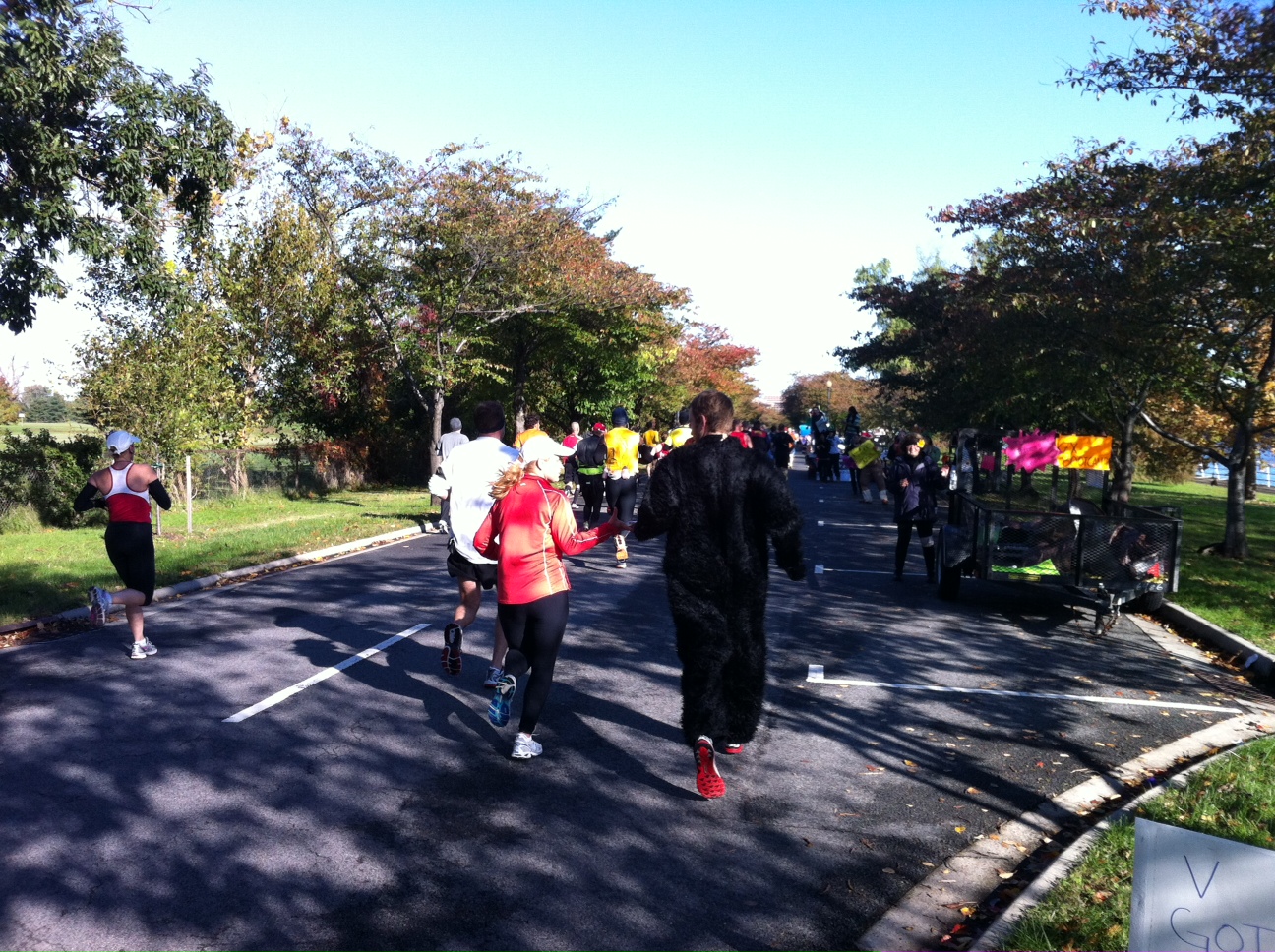
The gorilla handing off performance enhancing PowerGel.
This section of the course brings you along the Potomac river towards Hains Point.  Many people have a negative attitude towards Hains Point.  Lonely, boring, what have you.  I on the other hand adore Hains Point.  I spend a significant amount of time every week running and biking there and love the escape from the city it offers.  There was a surprising large amount of spectators down at Hains Point including a huge group at the end of the point for the 13.1 mile mark.  I hit the half-way point around 1:47 - a half-marathon PR and still right on target with my pace and 3:40 still in my sights.  At this point I had taken one gel at the one-hour mark and was preparing to take another at the two-hour mark.  I knew my brother and Kara would be on Hains Point and all of sudden there they were with a rowdy bunch from UMD cheering and of course Rory was in his gorilla suit, because why not?  I accepted 2 gels from the gorilla at mile 14 and ran on still feeling great.  Around mile 15 I really began to focus on holding my pace.  I was beginning to count down the miles and quite excited to be in the single digits very soon.  At mile 17 I cruised through "The Gauntlet" as I continued to hydrate every couple of miles.  I saw a fellow DC Tri-er as we headed toward the capital and gave him a shout out - I believe this was his first marathon as well.  I came around the capital and my legs were beginning to ache, specifically my quads.  As much as my heart, lungs, and body wanted to hold pace I began to feel like my legs wouldn't move.  I knew the last 6.2 was going to be all heart but I knew my pace was slowing as the 3:45 pace group swallowed me up whole at mile 19.  I stuck with them for about a mile and knew I had to let them go as we were nearing mile 20.  My 30k pace was 8:35min/mile with an estimated finish time of 3:45:02 still on track for a much better than expected finish time.


Miles 21-26.2
Nothing prepares you for what the last 10k is going to feel like.  My quads were barely working and mentally I was beginning to wonder if this would really be possible after a 2.4 mile swim and 112 mile bike ride.  I got my head back in the game and was ticking of the final 6.2 two miles at a time.  I was aware my pace was slowing, a lot.  I could only push as hard as I could push, which with two quads barely functioning is not hard.  I didn't walk, I ran on through Crystal City.  The Dunkin' Donut Munchkin stop was at miles 22 & 24 - I did not see a single runner take a Munchkin.  The smell made me want to gag.  Crystal city packed with spectators, cowbells, and voovoozelas, but no amount of encouragement or PowerGel was making my quads feeling any better.  Around mile 25 I saw Hugh, thanks to another runner who said "Hey, Hugh".  I promptly looked up and there was Hugh, by himself on the side of the highway cheering us on.  My 40k split had dropped to a 9:06min/mile pace with an estimated finish of 3:58:35.  I knew I could push on to take the Iwo but getting there under 4:00 was seeming to be a challenge.  Finally some orange slices, mile 26, a slight down hill and a sharp turn later I was beginning the climb up to Iwo Jima.  Running up hill actually felt better, probably because I used more glutes and less quads.  My brother and Kara were right there on the hill cheering their butts off for my one last push to the finish line.  26.2 done.


Waiting in a line for the finisher's medal was difficult my legs wanted to crumble but I think it was good for them to be forced to stay slightly active.  My mind was stuck on the fact that there was no way I would be able to do that at IM Louisville.  If I had been given the option right then to drop out or stay with it I may have just dropped out.  My lower portion of my face including mouth and jaw were numb, this a new sensation.  I collected my medal and space blanket and followed the hoards toward the food table on onward.  The spectators were kept to the other side of the fence from the athletes and I was not able to link back up with Rory and Kara at the finish line festival.  I downed some water and 1/2 a Gatorade which seemed to help the numbness of the mouth and jaw.  I continued making my way toward Rosslyn for the finish line festival while making a quick pit stop at a medical table for some Tylenol, though I really wanted Ibuprofen darn it.  It was quite a walk to the baggage check but I made it there just in time as per my usual about 15 minutes post finish I started shivering uncontrollably.  I promptly pulled out my fleece jacket and re-wrapped myself in my space blanket.  I headed back up the road to get a finisher's shirt and got in touch with my brother on the phone. In Halloween fashion the first solid food I ate after the race was a small pack of Reeses Pieces :) The place was insanely crowded and I did not have much energy to do anything and seeing that my brother and  Kara were walking toward home so we could all go to brunch I decided I would head that way too.  At first I thought I would Metro but the line was crazy insane just to get into the station so I scoped out a Circulator bus that took me to Dupont Circle to meet up with the brother. 
Great photo of Rory at the finish with DC in background.
A solid morning capped off with an awesome brunch, chocolate milk, and a super comfortable Lazy Boy.  I had earned it - never again will I run my first marathon.  I'm glad I did it.  I don't think I'll do another one before IM Louisville but I will run another marathon.  Possibly Chicago, NYC, St. George?  Eventually setting my eyes on a BQ.  The drop in pace was disappointing for me but a learning moment.  For now I will work back in strength training for triathletes/endurance athletes, continue to work on technique and build my cycling legs so 26.2 doesn't seem like such a daunting task at the end of an IronMan.  


What was you first marathon? How did you feel after?
36th Annual Marine Corps 2011!  My quads are non-functioning.  In PT language a large functional limitation for me would be sit --> stand.  I'm proud of the accomplishment and 1 day later I'm ready to train for and complete IM Louisville (not physically but mentally).


What is your favorite way to recover? 
I do love an ice bath but did not partake yesterday.  I always recover with chocolate milk.  Today I am headed into clinic to treat myself with e-stim and ice after a short 0 resistance elliptical session. The more I remind the legs to work the better off they are.


Did you race this weekend?  Are you doing any turkey trots?
The DC Tri Turkey Trot is next weekend with a 5k and a 10k option.  Depending on how I feel the 5k may be in the cards.  I am also doing the Huntsville Turkey Trot on Thanksgiving morning.